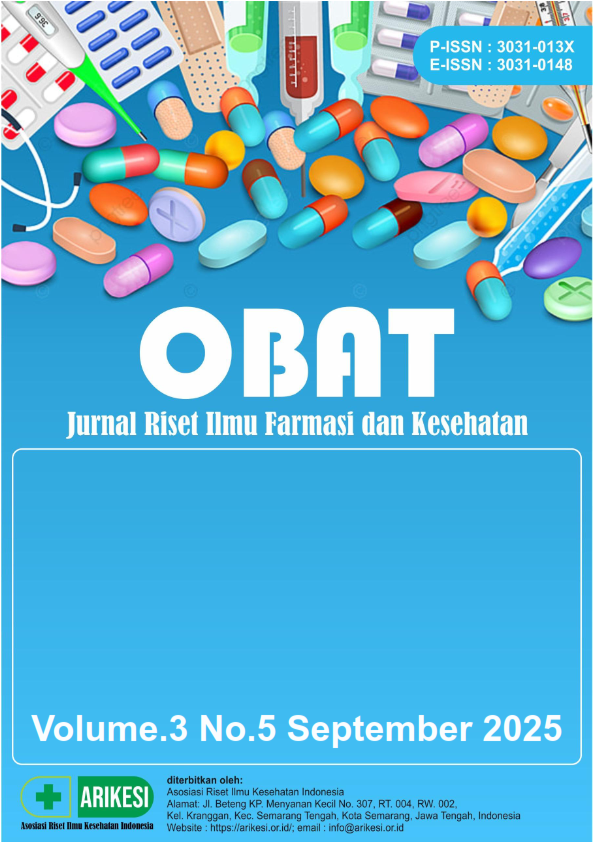
Kontribusi Resiliensi Akademik terhadap Subjective Well-Being pada Mahasiswa Akhir Program Studi Psikologi Universitas Negeri Padang
DOI:
https://doi.org/10.61132/obat.v3i5.1701Keywords:
Academic Resilience, Final Year Students, Subjective Well-BeingAbstract
Operationally, subjective well-being can be understood as an individual's assessment of their life experiences, involving affective components in the form of positive and negative emotions, as well as cognitive components. Individuals with subjective well-being experience more positive emotions and fewer negative emotions, and feel satisfied with their lives. One factor that influences subjective well-being is academic resilience. The purpose of this study was to determine the contribution of academic resilience to subjective well-being in final year psychology students at Padang State University. The research subjects were 174 final year psychology students at Padang State University who were taking thesis courses. The research design used was quantitative. Data collection used a non-probability sampling technique. Data were analyzed using simple regression analysis techniques. The analysis results obtained a sig. value of 0.000 (sig <0.05) with an r-square value of 0.550. From the results obtained, it was concluded that there was a contribution of academic resilience to subjective well-being in final year psychology students at Padang State University. The findings of this study strengthen the view that academic resilience is an important aspect in facing complex academic challenges, especially for final year students. Students with high levels of academic resilience tend to be better able to manage stress, maintain motivation, and remain focused on their academic goals despite facing various obstacles such as research difficulties, time pressure, and social demands. This ability directly contributes to increased life satisfaction and the dominance of positive emotions, which ultimately improves students' subjective well-being. Furthermore, the results of this study provide practical implications for universities to consider and develop programs that can improve students' academic resilience. For example, this could include providing counseling services, stress management skills training, and strengthening social support from supervisors and peers.
Downloads
References
Akhtar, H. (2019). Evaluasi properti psikometris dan perbandingan model pengukuran konstruk subjective well-being. Jurnal Psikologi, 18(1), 29-40.
Amelasasih, P., Aditama, S., & Wijaya, M. R. (2019, July). Resiliensi akademik dan subjective well-being pada mahasiswa. Proceeding National Conference Psikologi UMG 2018, 1(1), 161-167.
Aminudin, M. (2024, Januari 19). Motif mahasiswa Malang bunuh diri gegara depresi skripsi tak selesai. DetikJatim. https://www.detik.com/jatim/berita/
d-7132997/motif-mahasiswa-malang-bunuh-diri-gegara-depresi-skripsi tak-selesai.
Cassidy, S. (2016). The Academic Resilience Scale (ARS-30): A new multidimensional construct measure. Frontiers in Psychology, 7(Nov), 1–11. https://doi.org/10.3389/fpsyg.2016.01787.
Diener, E. (1984). Subjective well-being. Psychological Bulletin, 95(3), 542–575. https://doi.org/10.1037/0033-2909.95.3.542.
Diener, E. (2009). The science of well-being social indicators research series. Springer, 37, 11–58.
Diener, E., Emmons, R. A., Larsen, R. J., & Griffin, S. (1985). The satisfaction with life scale. Journal Of Personality Assessment, 49, 71-75.
Diener, E., Oishi, S., & Lucas, R. E. (2003). Personality culture, and subjective well‐being: Emotional and cognitive evaluation of life. Annual Review of Psychology, 54, 403–425.
Diener, E., Oishi, S., & Lucas, R. E. (2015). National accounts of subjective well-being. American Psychologist, 70(3), 234–242. https://doi.org/10.1037/
a0038899.
Diener, E., Suh, E. M., Lucas, R. E., & Smith, H. L. (1999). Subjective Well-Being : Three Decades Of Progress Subjective Weil-Being : Three Decades Of Progress. May 2014. Https://Doi.Org/10.1037/0033-2909.125.2.276
Eun, H., Young, K., & Sun, W. (2020). The impact of perfectionism and academic resilience on subjective well-being among Korean undergraduate students. Journal of Educational Psychology, 112(5), 951-962. https://doi.org/
10.1037/edu0000395.
Gafur, H. (2015). Mahasiswa dan dinamika dunia kampus. Bandung: CV. Rasi Terbit.
Hidayat, M. F. (2022). Kontribusi harga diri terhadap kesejahteraan subjektif mahasiswa yang mengerjakan skripsi masa pandemi COVID 19 di Universitas Negeri Padang. PAKAR pendidikan, 20(1), 13–23. https://doi.org/10.24036/pakar.v20i1.257
Iskandar, M. M., & Mastuti, E. (2022). Academic resilience, subjective well-being, online learning, dan COVID-19. Buletin Riset Psikologi Dan Kesehatan Mental (BRPKM), 2(1), 98–106. https://doi.org/10.20473/brpkm.v2i1.
31906.
Kalyana, A. D., & Uyun, Z. (2024). Self efficacy pada mahasiswa semester akhir dalam mengerjakan skripsi (Doctoral dissertation, Universitas Muhammadiyah Surakarta).
Kao, P. C. (2024). Exploring the roles of academic expectation stress, adaptive coping, and academic resilience on perceived English proficiency. BMC Psychology, 12, Article 158. https://doi.org/10.1186/s40359-024-01630-y.
Kumalasari, D., Luthfiyani, N. A., & Grasiawaty, N. (2020). Analisis faktor adaptasi instrumen resiliensi akademik versi Indonesia: Pendekatan eksploratori dan konfirmatori. Jurnal Penelitian dan Pengukuran Psikologi: JPPP, 9(2), 84-95.
Linsiya, R. W. (2022). Hubungan kecenderungan neurotik dengan subjective well-being pada mahasiswa yang menyelesaikan skripsi. Jurnal Insight Fakultas Psikologi Universitas Muhammadiyah Jember, 18(1), 99–106. https://doi.org/10.32528/ins.v
Mallick, M. K., & Kaur, S. (2016). Academic resilience among senior secondary school students: Influence of learning environment. Rupkatha Journal on Interdisciplinary Studies in Humanities, 8(2), 20–27. https://
doi.org/10.21659/rupkatha.v8n2.03.
Marfuatunnisa, N., & Sandjaja, M. (2023). Stres akademik pada mahasiswa yang mengerjakan skripsi di indonesia ditinjau dari academic help-seeking dan resiliensi akademik. Jurnal Diversita, 9(2), 218–227. https://doi.org/10.31-289/diversita.v9i2.9356
Martin, A. J., & Marsh, H. W. (2003). Academic resilience and academic buoyancy: Multidimensional and hierarchical conceptual framing of causes, correlates, and cognate constructs. Oxford Review of Education, 29(3), 37–41. https://doi.org/10.1080/03054980902934639.
Martin, A. J., & Marsh, H. W. (2006). Academic resilience and its psychological and educational correlates: A construct validity approach. Psychology in the Schools, 43(3), 267-281. https://doi.org/10.1002/pits.20149.
Maulidhah, C. R. P., & Fahmawati, Z. N. (2024). Hubungan optimisme dan resiliensi akademik dengan subjective well-being pada siswa SMA Negeri 1 Krian. Jurnal Psikologi Universitas Muhammadiyah Sidoarjo.
Morales, E. E., & Trotman, F. K. (2004). Promoting academic resilience in multicultural America: Factors affecting student success. Peter Lang Publishing.
Myers, D. G., & Diener, E. (1995). Who is happy? Psychological science, 6(1), 10–19. Retrieved June 21, 2004, from http://www.acsu.buffalo.edu/
~kashdan/happy.pdf
Noviana, R., Suzanna, E., & Muna, Z. (2023). Resiliensi akademik pada mahasiswa psikologi universitas malikussaleh dalam penyusunan skripsi. Jurnal Psikologi Pendidikan dan Perkembangan, 11(1), 45-55.
O’Connor, E. (2005). Student well‐being: A dimension of subjective well‐being?. http://acqol.deakin.edu.au/theses/OConnor.
Okvellia, C., & Setyandari, A. (2022). Resiliensi akademik mahasiswa tingkat akhir program studi Bimbingan dan Konseling tahun ajaran 2021/2022. Solution: Journal of Counselling and Personal Development, 4(2), 18-24.
Puteri, I. A. W. (2020). Asertivitas dan subjective well-being pada mahasiswa di masa pandemi covid-19. Jurnal Psikologi Malahayati, 2(2), 86–93. Https://Doi.Org/10.33024/Jpm.V2i2.3066.
Rahmanda, S., & Utami, R. H. (2024). Hubungan antara peer support dan subjective well-being pada mahasiswa tingkat akhir Universitas Negeri Padang. InTrend: Jurnal Psikologi, 1(1), 1–10.
Rahmi, F., Hasnida, R., & Wulandari, L. H. (2019). Effect of academic resilience on subjective well-being of students in islamic boarding schools. International Research Journal of Advanced Engineering and Science, 4(3), 347-349.
Ramadanti, G., & Sofah, R. (2020). Resiliensi akademik pada siswa berdasarkan prestasi belajar. Prosiding seminar nasional bimbingan dan konseling universitas negeri malang: Promosi Layanan Konseling Berbasis Kabar Gembira dalam Era Pluralisme.
Rita, E, (2011). Perkembangan peserta didik. Yogyakarta : UNY Prees.
Rozi, F. (2024, Desember 8). Meninggal setelah proses skripsi, mahasiswi BKPI IAIN Madura diduga alami depresi akibat beban akademik. Suaranet. https://www.suaranet.id/2024/12/08/meninggal-setelah-proses-skripsi-mahasiswi-bkpi-iain-madura-diduga-alami-depresi-akibat-beban-akademik/.
Sandjaja, M. (2023). Prestasi sebagai mediator achievement goal orientation dan subjective well-being mahasiswa.
Safitri, N. A., & Nawangsih, R. A. (2022). Pengaruh optimisme dan resiliensi akademik untuk meningkatkan subjective well-being pada mahasiswa yang menjalani perkuliahan daring. Jurnal Ilmiah Psikomuda Connectedness, 1(2), 1-21.
Saputri, R. A., & Hidayah, N. (2020). Regulasi emosi dan dampaknya terhadap kesejahteraan psikologis mahasiswa tingkat akhir. Jurnal Psikologi Pendidikan dan Konseling, 6(2), 123–132.
Sari, P. K. P., & Indrawati, E. S. (2017). Hubungan antara dukungan sosial teman sebaya dengan resiliensi akademik pada mahasiswa tingkat akhir jurusan x fakultas teknik universitas diponegoro. Jurnal Empati, 5 (2), 177-182. https://doi.org/10.14710/empati.2016.14979.
Sari, S. R., & Utami, R. H. (2024). Kontribusi harga diri terhadap kesejahteraan subjektif mahasiswa yang mengerjakan skripsi masa pandemi covid-19 di Universitas Negeri Padang. In Trend: International Journal of Trends in Global Psychological Science and Education, 2(1). https://doi.org/10.62-260/intrend.v2i1.337.
Wijayanti, R. K., Fitriana, S., & Ajie, G. R. (2021). Hubungan antara motivasi berprestasi dengan resiliensi akademik mahasiswa dalam penyelesaian skripsi. Jurnal Pendidikan Dan Pembelajaran, 1, 33–42.
Yeager & Dweck. (2012). Mindsets that promote resilience: When students believe that personal characteristics can be developed. Educational Psychologist, 47(4), 302-314. DOI: 10.1080/00461520.2012.722805.
Downloads
Published
How to Cite
Issue
Section
License
Copyright (c) 2025 OBAT: Jurnal Riset Ilmu Farmasi dan Kesehatan

This work is licensed under a Creative Commons Attribution-ShareAlike 4.0 International License.